Taylor Bubble Dynamics in Counter-Current Turbulent Flow
Numerical and experimental investigation of Taylor bubble breakup and interface dynamics using LES and VOF methods
This research investigates the dynamics of Taylor bubbles in vertical counter-current turbulent flows. The work combines high-fidelity Large Eddy Simulation (LES) with experimental validation to understand bubble breakup mechanisms and interface behavior.
Project Overview
Taylor bubbles are large gas structures that form in vertical pipes during slug flow regimes. Understanding their behavior in counter-current flow is crucial for nuclear reactor safety, particularly in emergency core cooling scenarios. The project combined simulations and experiments of a bubble held stationary by a downward liquid flow, which makes it possible to observe breakup and interface dynamics over long periods.
Key Findings
Bubble Shape Evolution
Experiments showed that the bubble shape depends on the flow regime:
The high-resolution simulations show a secondary vortex in the turbulent wake region behind the bubble, which had not been reported for counter-current Taylor bubble flows. It is most prominent at finer mesh resolutions.
Interface Wave Dynamics
Interface tracking on high-speed camera images captured disturbance waves along the bubble interface with amplitudes of 10–100 μm. The waves move in a correlated way across the bubble surface.
Simulated Taylor bubbles in counter-current flow, coloured by the liquid velocity Ux, next to an experimental image of the bubble (right).
Computational Methods
Numerical Framework
Solver: Modified OpenFOAM with enhanced VOF capabilities
Time Integration: High-order Diagonally Implicit Runge-Kutta (DIRK) schemes
Interface Reconstruction: Piecewise Linear Interface Calculation (PLIC) method
Turbulence Modeling: Wall-Adapting Local Eddy-viscosity (WALE) model
Method Comparison
A comparison of algebraic and geometric interface capturing in the transitional regime (Re = 1400) showed that geometric reconstruction predicts bubble breakup more accurately.
Impact and Applications
This research supports:
Nuclear reactor safety analysis for emergency cooling scenarios
Multiphase flow prediction in vertical pipes and channels
Interface tracking method development for complex geometries
Understanding of turbulent wake structures in multiphase systems
The stagnant Taylor bubble in vertical isothermal turbulent counter-current flow was analyzed using 2D shadowgraphy experiments and two distinct high-fidelity numerical simulations. One simulation employed the geometrical VOF interface tracking method within the OpenFOAM framework, while the other utilized the explicit front tracking method of the TrioCFD code. Interface recognition algorithms were applied to the photographs and compared with the results of 3D simulations performed with LES and pseudo-DNS accuracy in OpenFOAM and TrioCFD, respectively. The measured Taylor bubbles exhibited an asymmetric bullet-train shape and a specific speed, which were compared with the predictions of both numerical approaches. Reproducing the experiment proved challenging for both otherwise well-established methods frequently used in interface tracking simulations of two-phase flows.
Capillary waves on the liquid film of a Taylor bubble in vertical countercurrent flow
Iztok Tiselj, Samir El Shawish, Jan Kren, and 2 more authors
This study reports the identification of a previously uncharacterized type of capillary wave on the moving interface of a Taylor bubble in vertical countercurrent flow. In our experiments, the buoyancy of the Taylor bubble is precisely balanced by a downward laminar water flow (Re= 1400) within a 12.4 mm diameter glass pipe. These previously uncharacterized waves appear at a height one-fourth to one-half of the pipe diameter above the bubble’s tail and remain stationary in the laboratory frame, implying that their upward propagation speed exactly matches the downward motion of the interface.
2024
Numerical study of Taylor bubble breakup in counter-current flow using large eddy simulation
Jan Kren, E. M. A. Frederix, Iztok Tiselj, and 1 more author
This paper investigates dynamics of Taylor bubble in counter-current flows, leveraging large eddy simulations combined with the volume of fluid method. Utilizing the OpenFOAM framework, we have implemented a high-order Runge–Kutta time-integration scheme, along with a piecewise linear interface calculation method for precise geometric reconstruction of the bubble interface. We examine the performance of algebraic vs geometric capturing techniques in the context of Taylor bubble breakup, focusing specifically on the transitional flow regime with a liquid Reynolds number of 1400. Our results reveal that the geometric capturing technique offers superior accuracy, improving our understanding of the breakup process and providing valuable insight for multiphase flow simulations in various engineering fields. Our study also reveals the emergence of a secondary vortex in the turbulent wake region behind the Taylor bubble, a phenomenon most prominent at finer mesh resolutions. This vortex represents a novel discovery in counter-current Taylor bubble flows.
Taylor Bubble Breakup in Counter-Current Turbulent Flow Using Algebraic and Geometric Volume of Fluid Method
This thesis presents an in-depth investigation of Taylor bubbles in counter-current flows, employing a dual approach of high-fidelity numerical simulations and state-of-the-art experimental techniques. Taylor bubble is one of the manifestations of two-phase slug flow in a pipe. It consists of large gas bubbles separated from each other by slugs of the liquid phase. The dynamics of Taylor bubbles in air-water mixture were examined in two different regimes - the transitional flow regime with Reynolds number \Re = 1400 and the fully turbulent flow with \Re = 5600\. The study focused on bubbles of various lengths in stagnant conditions, where buoyancy is counterbalanced by inertial drag in the downward turbulent flow. The experimental study focuses on three main aspects: the analysis of bubble disintegration, the detailed analysis of the bubble interface dynamics and measurement of velocity fields using Particle Image Velocimetry (PIV) technique. By developing specialized algorithms for interface reconstruction from the obtained high-speed camera images, the research identified asymmetric, bullet-train-like shapes of Taylor bubbles in fully turbulent flow, but axi-symmetric bubbles in transitional liquid flow. This was a significant finding, demonstrating also the presence of disturbance waves along the bubble interface, which were tracked with high sensitivity. These waves exhibited correlated movements across the bubble surface, adding new understanding to the behavior of such flows. The numerical study focused on the bubble behavior and breakup mechanisms, highlighting the limitations of the numerical methods. Using the OpenFOAM framework, the research implemented a high-order Runge-Kutta time-integration scheme combined with the Volume-Of-Fluid (VOF) method and the geometric reconstruction of bubble interfaces. The study concentrated on the transitional flow regime with a liquid \Re=1400 comparing algebraic and geometric capturing techniques. The results highlighted the superiority of geometric reconstruction in capturing the nuances of Taylor bubble breakup. A novel discovery was also the emergence of a secondary vortex in the turbulent wake of the Taylor bubble, particularly noticeable at finer mesh resolutions. This thesis contributes to the field of nuclear engineering and fluid dynamics by providing a more comprehensive understanding of Taylor bubble behavior in counter-current flows. The combination of experimental observations and numerical simulations offers a holistic view, paving the way for improved designs and operations in various engineering fields where such flow phenomena are encountered.
2023
Dynamics of Taylor bubble interface in vertical turbulent counter-current flow
Jan Kren, Boštjan Zajec, Iztok Tiselj, and 4 more authors
International Journal of Multiphase Flow, Aug 2023

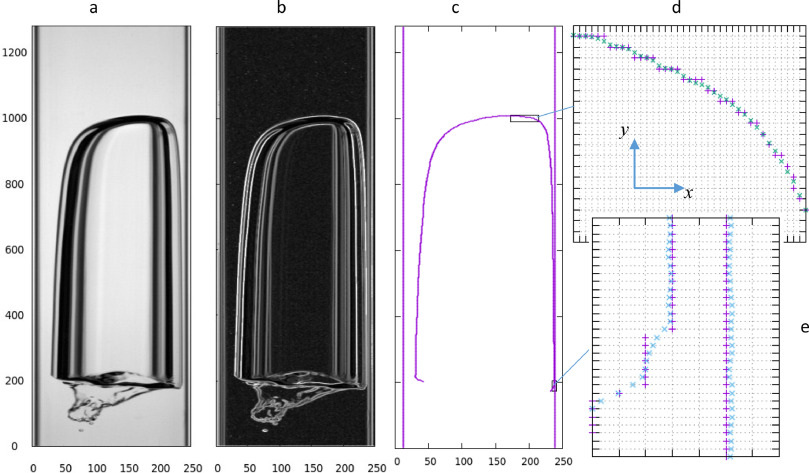 Dynamics of Taylor bubble interface in vertical turbulent counter-current flowInternational Journal of Multiphase Flow, Aug 2023
